

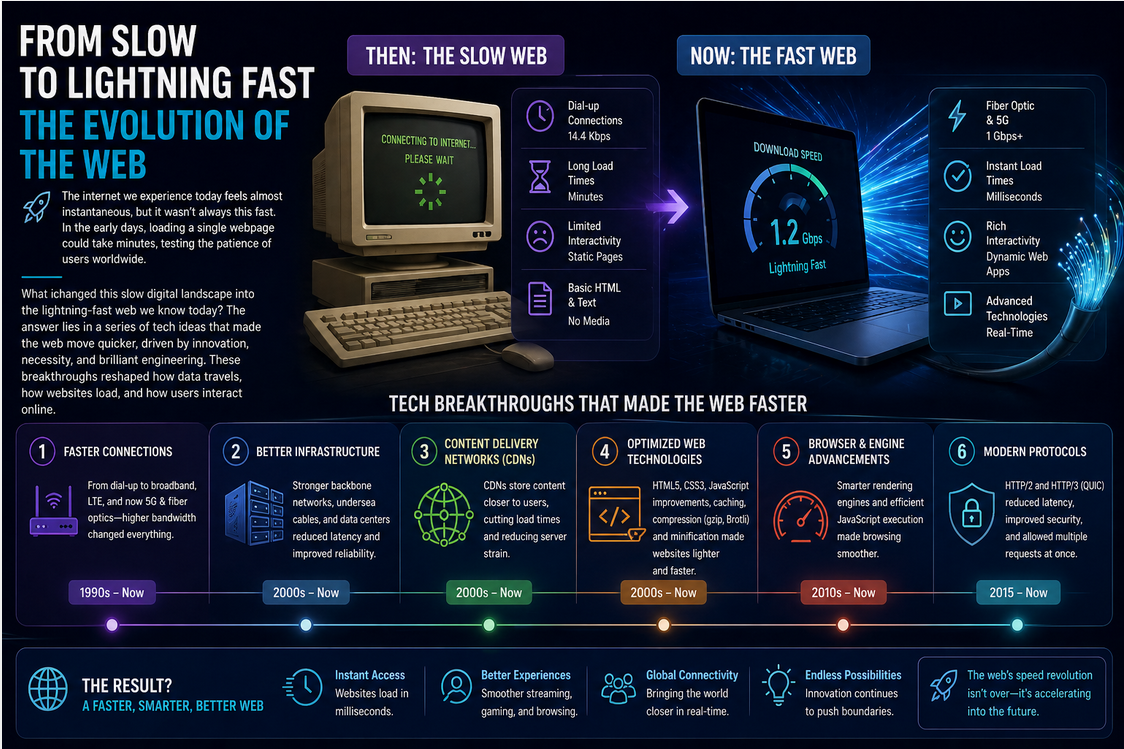
The internet we experience today feels almost instantaneous, but it wasn’t always this fast. In the early days, loading a single webpage could take minutes, testing the patience of users worldwide. What changed this slow digital landscape into the lightning-fast web we know today? The answer lies in a series of tech ideas that made the web move quicker, driven by innovation, necessity, and brilliant engineering. These breakthroughs reshaped how data travels, how websites load, and how users interact online.
The Evolution of Web Speed and Performance
Understanding the importance of speed begins with looking back at the early 1990s internet era, when dial-up connections dominated. Websites were simple, yet painfully slow due to limited bandwidth and inefficient data handling. As user demand grew, developers and engineers began introducing solutions to reduce latency and improve performance.
Over time, these improvements were not just incremental but revolutionary. Each advancement built upon the previous one, forming a network of optimizations that transformed the web into a high-speed ecosystem capable of handling billions of users simultaneously.
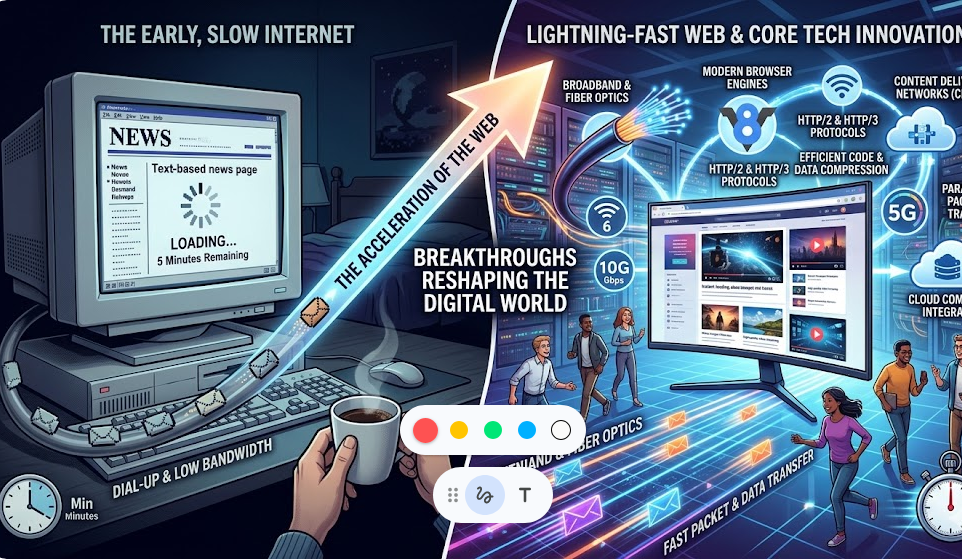
Compression Technologies That Reduced Data Size
One of the most impactful tech ideas that made the web move quicker was data compression. By reducing file sizes, websites could load faster without compromising too much quality.
Gzip compression, introduced in the late 1990s, became a standard method for shrinking HTML, CSS, and JavaScript files before sending them over the network. Later, Brotli, developed by Google in 2015, offered even better compression rates.
These technologies work by eliminating redundancies in data, allowing browsers to download content more efficiently. As a result, users experience faster load times, especially on slower connections or mobile networks.
Content Delivery Networks (CDNs) and Global Distribution
The introduction of Content Delivery Networks (CDNs) revolutionized how content is delivered across the globe. Instead of relying on a single server, CDNs distribute content across multiple geographically located servers.
Key benefits include:
- Reduced latency by serving content closer to users
- Improved reliability and uptime
- Faster delivery of images, videos, and scripts
Companies like Akamai and Cloudflare played a significant role in popularizing this approach. CDNs remain one of the most effective solutions for improving website performance worldwide.
Browser Caching and Efficient Resource Storage
Another major advancement involves browser caching, which allows frequently accessed resources to be stored locally on a user’s device. This means that when a user revisits a website, the browser doesn’t need to download everything again.
Caching significantly reduces load times and bandwidth usage. It works by storing files like images, stylesheets, and scripts, enabling near-instant access on subsequent visits.
This idea, though simple, has had a profound impact on web performance, making it a cornerstone among tech ideas that made the web move quicker.
The Rise of Asynchronous Loading (AJAX)
Before AJAX (Asynchronous JavaScript and XML), web pages had to reload entirely whenever new data was requested. This created delays and disrupted user experience.
AJAX changed this by allowing data to be fetched in the background without refreshing the page. Introduced in the early 2000s, it enabled smoother interactions and faster updates.
Examples of AJAX benefits include:
- Real-time search suggestions
- Dynamic content updates
- Seamless user interactions
This innovation laid the foundation for modern web applications, including social media platforms and online collaboration tools.
HTTP/2 and HTTP/3 Protocol Improvements
The evolution of web protocols has been critical in improving speed. HTTP/2, introduced in 2015, brought major enhancements such as multiplexing, header compression, and server push.
Later, HTTP/3, built on the QUIC protocol, further reduced latency and improved connection reliability. These protocols allow multiple requests to be handled simultaneously, eliminating bottlenecks that slowed down earlier versions.
Such advancements ensure faster communication between servers and browsers, making them essential components of modern web infrastructure.
Image Optimization and Modern Formats
Images often make up a large portion of web content, and optimizing them has been crucial for improving speed. Traditional formats like JPEG and PNG were replaced or complemented by modern formats such as WebP and AVIF.
These formats provide:
- Smaller file sizes with high quality
- Faster loading times
- Better performance on mobile devices
By reducing image weight, websites can load more quickly, enhancing both user experience and search engine rankings.
JavaScript Optimization and Minification
JavaScript plays a vital role in web functionality, but large scripts can slow down performance. Developers addressed this by introducing optimization techniques like minification and bundling.
Minification removes unnecessary characters, while bundling combines multiple files into one. These techniques reduce the number of requests and the size of data transferred.
Frameworks and tools have also evolved to ensure efficient execution, making JavaScript optimization another key factor among tech ideas that made the web move quicker.
Mobile Optimization and Responsive Design
With the rise of smartphones, optimizing websites for mobile devices became essential. Mobile networks often have slower speeds compared to broadband, requiring efficient design strategies.
Responsive design ensures that websites adapt to different screen sizes and devices. Combined with lightweight coding practices, this approach improves loading times and usability.
Mobile-first development has become a standard, ensuring that users enjoy fast experiences regardless of their device.
Edge Computing and Faster Data Processing
Edge computing is a relatively recent innovation that processes data closer to the user rather than relying on centralized servers. This reduces the distance data must travel, significantly improving speed.
Benefits of edge computing include:
- Lower latency
- Faster response times
- Improved real-time performance
This approach is especially important for applications like streaming, gaming, and IoT devices, where speed is critical.
DNS Optimization and Faster Domain Resolution
The Domain Name System (DNS) acts as the internet’s address book, translating domain names into IP addresses. Early DNS lookups could cause delays, but modern optimizations have improved this process.
Techniques such as DNS caching and faster resolution protocols help reduce lookup times. Services like Google Public DNS and Cloudflare DNS have further enhanced performance.
Efficient DNS handling ensures that users can connect to websites quickly, reducing initial load delays.
Lazy Loading and Resource Prioritization
Lazy loading is a technique that delays the loading of non-essential resources until they are needed. For example, images below the fold are only loaded when the user scrolls down.
This approach reduces initial page load time and improves performance. It is particularly useful for content-heavy websites.
By prioritizing critical resources, developers ensure that users can interact with a page more quickly, enhancing overall experience.
The Role of Artificial Intelligence in Web Speed
Artificial Intelligence is now playing a growing role in optimizing web performance. AI algorithms can analyze user behavior, predict resource needs, and optimize delivery in real time.
Examples include:
- Smart caching strategies
- Automated image compression
- Predictive loading of content
These innovations represent the next generation of tech ideas that made the web move quicker, pushing the boundaries of speed and efficiency.
Security Enhancements That Improved Performance
Security and speed are often seen as opposing forces, but modern technologies have managed to balance both. Protocols like HTTPS and TLS 1.3 not only secure data but also improve connection efficiency.
Faster handshakes and optimized encryption processes reduce delays, ensuring that secure websites load quickly. This integration of security and performance has become essential in today’s web environment.
Key Takeaways From Web Speed Innovations
The journey of web performance improvements highlights the importance of continuous innovation. Some of the most impactful ideas include:
- Data compression technologies like Brotli
- Global content delivery through CDNs
- Advanced protocols such as HTTP/3
- Optimization techniques for images and scripts
- Emerging solutions like edge computing and AI
Each of these contributions has played a role in shaping the fast, responsive web we rely on today.
Conclusion
The transformation of the internet from slow, static pages to dynamic, high-speed platforms is a testament to human ingenuity. The tech ideas that made the web move quicker have not only improved performance but also redefined how we interact with digital content.
As technology continues to evolve, new innovations will further enhance speed, reliability, and user experience. Understanding these advancements provides valuable insight into the foundations of the modern web and its exciting future.
FAQs
1. What are the most important tech ideas that improved web speed?
Key ideas include compression technologies, CDNs, modern protocols like HTTP/3, and optimization techniques for images and scripts.
2. How do CDNs make websites faster?
CDNs store content on servers worldwide, delivering it from locations closer to users, reducing latency and load times.
3. What is the role of HTTP/3 in web performance?
HTTP/3 improves speed by reducing latency and enhancing connection reliability using the QUIC protocol.
4. Why is image optimization important?
Optimized images reduce file sizes, allowing faster loading without compromising quality.
5. How does caching improve web speed?
Caching stores frequently accessed data locally, reducing the need to download resources repeatedly.
6. What is lazy loading?
Lazy loading delays the loading of non-essential resources until they are needed, improving initial page load time.
7. How does AI help in web optimization?
AI enhances performance through predictive loading, smart caching, and automated optimization techniques.
Get more updates or Stories on The AI Pedia
